
Photo: Linnea Bengtsson
Military experience and research come together at the Swedish Defence University
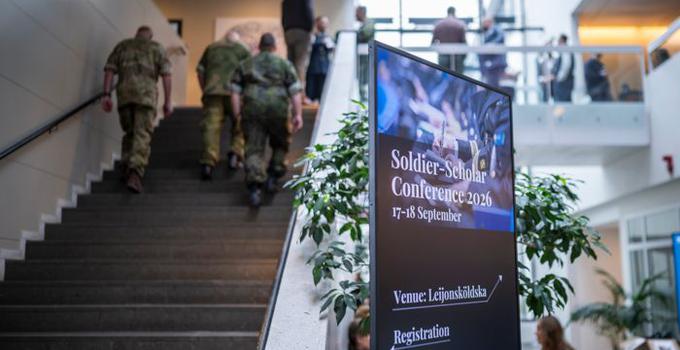
On 17–18 September, researchers with military backgrounds gathered for the Soldier-Scholar Conference 2026. Over two days, they discussed topics including warfare and strategy, military leadership and learning, and what it means to combine a military career with research.
The conference is organised at the Swedish Defence University as part of the Research School for War and Defence, an international research school for doctoral students with military backgrounds. The conference attracted participants from Sweden, Norway, Denmark, Estonia, the United Kingdom and the United States, among other countries. Several of the participants combine research with military experience, which was also a recurring theme throughout the conference.
The conference opened with an address by David Bergman, Director of Research at the Swedish Armed Forces and an affiliated researcher at the Swedish Defence University. This was followed by the conference keynote address by John Olsen, Professor of War Studies at the Swedish Defence University and a Colonel in the Norwegian Armed Forces, who spoke about the military leadership of US Air Force General Chuck Horner.
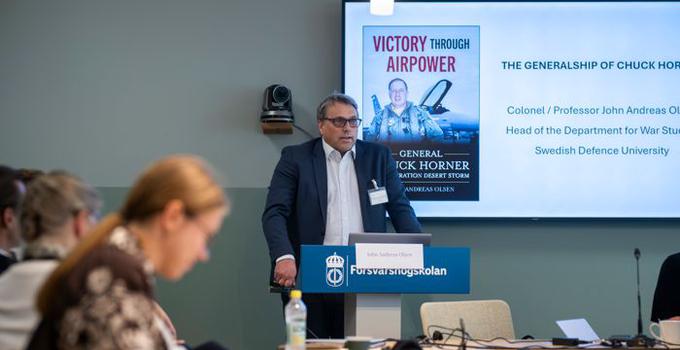
John Olsen, Professor of War Studies at the Swedish Defence University and Colonel in the Norwegian Armed Forces. Photo: Linnea Bengtsson
From strategy to military identity
The first day featured two research panels, the first of which focused on strategy and warfare. Topics discussed included Nordic perspectives on success in military operations, the significance of space for crisis management, and NATO’s deterrence and defence in a situation marked by political divisions within the Alliance.
The second panel explored norms, identity and perceptions within military organisations. The presentations addressed ideals of military leadership, professional identity and how young military personnel envisage future security threats. The panel also discussed different ways of understanding civil–military relations in the context of strategic competition.
The day concluded with a poster session presenting research on topics including tactical initiative among Swedish company commanders, digital transformation in the Norwegian Armed Forces and military growth.
One of the participants was Thomas Vrenngård, a Lieutenant Colonel and Doctoral Student at the Department of Leadership and Command & Control at the Swedish Defence University. He presented a poster on his doctoral research project, in which he studies tactical decision-making among Swedish Army company commanders and how the leadership of their superior commanders influences their decisions.
"We can draw inspiration from other people’s methods and provide constructive criticism that is also informed by professional military knowledge", he says, describing the value of bringing together military doctoral students and soldier-scholars from different countries and academic disciplines.
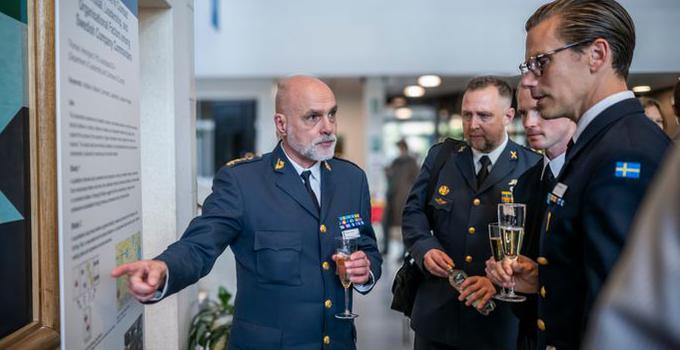
Thomas Vrenngård, Lieutenant Colonel and Doctoral Student (left), shows his poster to a group including David Bergman (second from left), Director of Research at the Swedish Armed Forces and an Affiliated Researcher at the Swedish Defence University. Photo: Linnea Bengtsson
How do military organisations learn?
The second day of the conference turned its attention to learning in military organisations. The researchers addressed topics including learning in operational logistics within the Nordic defence cooperation framework NORDEFCO, resistance to gender equality initiatives, and opportunities for experimentation in professionalised bureaucracies.
The conference concluded with a round-table discussion in which participants from the Swedish Defence University, the Swedish Armed Forces, the Royal Danish Defence College and the U.S. Military Academy discussed the practicalities of combining the military profession with academic work.
For Thomas Vrenngård, the conference also provided an opportunity to reflect on the opportunities and challenges involved in combining the two roles.
"One insight is how more experienced soldier-scholars describe how rewarding it is and how this dual expertise can have a tangible impact both within the military and in academia, while many also point to the lack of career paths specifically for soldier-scholars."
He also highlights how people with first-hand experience of the military profession can contribute particular perspectives to research.
"For example, we can identify phenomena for further research that civilian academics would probably overlook", he says.
Research School for War and Defence
Read more about the International Research School at the Swedish Defence University:
Research School for War and Defence
Page information
- Published:
- 2026-09-21
- Last updated:
- 2026-09-22