
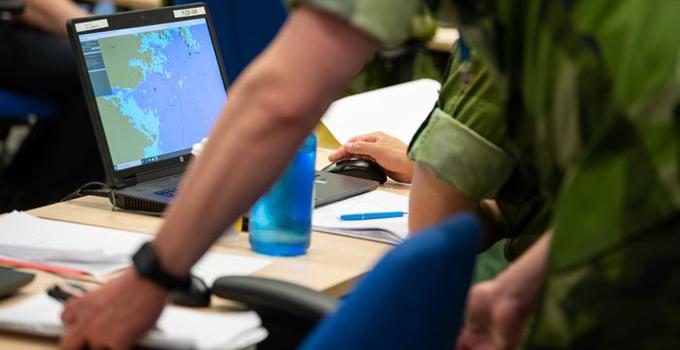
Lars Henåker has, among other methods, used wargaming to examine which personal characteristics may contribute to winning or losing in combat. Photo: Anders G Warne.
PhD thesis explores what influences the outcome of combat
What determines whether one wins in combat? This is the overarching research question in Lars Henåker’s thesis, the findings of which indicate, among other things, that the so-called dependent decision-making style—where one seeks consensus before making decisions—more often leads to defeat.
In his thesis Mastering Tactics: Exploring and Measuring Victory in Battle, Lars Henåker, Lieutenant Colonel and Senior Lecturer at the Swedish Defence University, examines how the probability of winning in combat can be increased. The purpose of the thesis was to test existing theory and analyse the factors that influence outcomes in combat in order to explain what leads to tactical victory.
“I wanted to gain a deeper understanding of effective tactics and of how personal characteristics influence tactical decisions”, says Lars Henåker, emphasising that his focus is specifically on combat situations rather than war as a whole.
In the first of three sub-studies, he analyses a tactical model—the ideal model—divided into eight steps and used to measure the outcome of combat.
“Our results indicate that the likelihood of winning in combat increases the more closely the model is followed”, he says.
This is partly because the model is based on manoeuvre warfare, which focuses on achieving surprise and exploiting the enemy’s weaknesses. In the second sub-study of the thesis, he examines manoeuvre warfare more closely.
“What I find here is that the approach still holds. Manoeuvre warfare is the opposite of attrition warfare and, in simple terms, is about achieving surprise and avoiding predictability in combat. It is this type of approach that enables a smaller state to defeat a larger one”, he explains.
Wargaming to examine the tactical model and leadership styles
The final part of the thesis consists of an experimental study in the form of wargaming, involving more than 100 participants, designed to test the ideal model. Lars Henåker also analyses five different decision-making styles—rational, intuitive, avoidant, spontaneous and dependent—to investigate whether personal characteristics can determine whether one wins or loses in combat.
The experiments do not produce clear results regarding what leads participants to win in combat; however, they do show that those who lost more often exhibited a dominant dependent decision-making style.
“Here we have statistically significant evidence that those with a dependent decision-making style were more likely to lose the duels in the experiments.”
A dependent decision-making style involves, among other things, taking others’ views into account before making decisions and preferring to reach consensus ahead of major decisions.
“Most people fall somewhere within these five models. You may have elements of two, and some individuals perhaps even three, but usually one is dominant.”
The dependent decision-making style is also characterised by individuals who avoid making decisions when possible. It is linked to feelings of inadequacy as a decision-maker and has been associated with tendencies towards low self-confidence and a lack of initiative in decision-making situations.
“This knowledge can be used in the education of our officers and in the training of our units”, says Lars Henåker.
Extensive experience in the Army
His research interest stems from more than 35 years of experience as an officer in the Army.
“Measuring or evaluating success in combat has not previously been done routinely within the Swedish Armed Forces. If you search for terms such as victory or defeat in the Armed Forces’ manuals and doctrines, you will find surprisingly little information. Either it has been taken for granted, or there has been no method for measuring or assessing success in combat, and instead people have relied more on intuition. But then one has not examined the craft itself—that is, why things have gone well or badly” he says, continuing:
“It frustrated me that we could not measure or evaluate defeat and victory in combat, and my research interest has grown out of these questions.”
Contributes to the development of Armed Forces tactics
Lars Henåker’s articles have already begun to be used in teaching at the Swedish Defence University, and the hope is that the findings will be incorporated into future work on the development of Army tactics.
“I also work as the principal instructor in War Studies at the Land Warfare Centre in Skövde, and I believe my research can make a concrete practical contribution, as well as to the development of the Army’s future tactics.”
Publication
Lars Henåker (2023): Mastering Tactics: Exploring and measuring victory in battle
Lars Henåker defended his PhD thesis in War Studies on 29 March 2023 at the Department of War Studies, Swedish Defence University.
Page information
- Published:
- 2023-03-24
- Last updated:
- 2026-04-28