
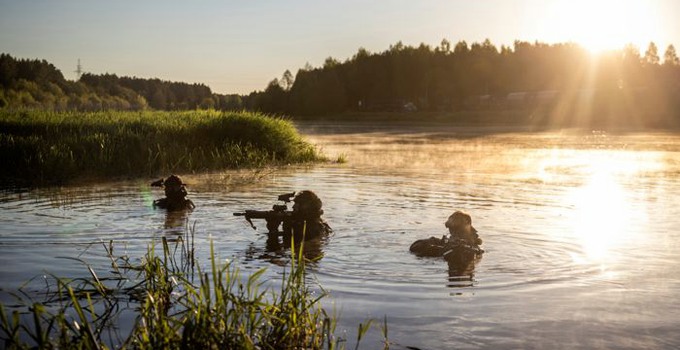
Combat divers at an excercise. Photo: Antonia Sehlstedt/Swedish Armed Forces
Common workplace safety surveys miss risks in military hierarchies
A new study shows that civilian-designed surveys intended to measure safety culture often fall short in military organisations, potentially leading to risks being overlooked. The reason is that obedience and high exposure to risk are deeply embedded in military environments.
“In a hierarchical setting like the armed forces, it’s not always natural to question orders or even report risks,” says Major Martin Schüler, the researcher behind the study published in the scientific journal Safety Science.
Schüler, an officer and PhD in Work-Integrated Learning, examined the civilian-developed tool Nordic Safety Climate Questionnaire (NOSACQ-50). While this tool is widely used in occupational safety research and recommended by the Swedish Work Environment Authority, has proven to be less effective in military contexts.
Questions are misunderstood
“The questions are based on assumptions of participation, voluntariness, and openness. In many military situations, such conditions are absent — for example, during live-fire exercises involving both conscripts and professional officers. The response options in the questionnaire are therefore not well suited to such environments and often result in questions being misunderstood or ignored by military personnel,” says Schüler.
In the study, Schüler analysed how military personnel interpret statements from three previously published safety data collections. One example of a problematic item is: “We always discuss safety issues when they arise.” Regardless of role, workplace, or rank, respondents chose the same answer: “Applies fairly well.”
Schüler argues that an entirely different approach is needed for systematic workplace safety efforts to function effectively in the military — particularly those based on voluntary reporting of problems and hazards.
Developed an adapted survey
To address the shortcomings, Schüler developed and tested an improved version of the survey, called NOSCQ-35, which showed better precision and less noise. The results also suggest that an ultra short version with just seven statements could be used to monitor safety culture, for example in the Swedish Armed Forces’ employee survey (called FM Vind).
“These versions are easier to use and better suited to the military, where high risk is part of daily life and questioning can be seen as disloyal,” says Schüler, who works both within the Swedish Armed Forces and as a researcher at the Swedish Defence University’s Department of Leadership and Command & Control.
The goal is for the adapted questionnaire to provide a clearer understanding of safety culture within military operations and, ultimately, help reduce incidents and injuries.
Critical thinking is essential
The findings highlight a broader issue: workplace safety regulations are often based on civilian norms, which may not align with the realities of military life. According to Schüler, promoting safety in hierarchical organisations requires more than written rules and procedures — it also depends on strong leadership, psychological safety, critical thinking, and the judgement to speak up when it really matters.
Schüler has previously studied accidental discharges within the Swedish Armed Forces.
Publication
Martin Schüler: Validating a shortened version of the Nordic Safety Climate Questionnaire (NOSACQ) on a military population, Safety Science
DOI: https://doi.org/10.1016/j.ssci.2025.106946
More about
Page information
- Published:
- 2025-07-30
- Last updated:
- 2025-08-21