
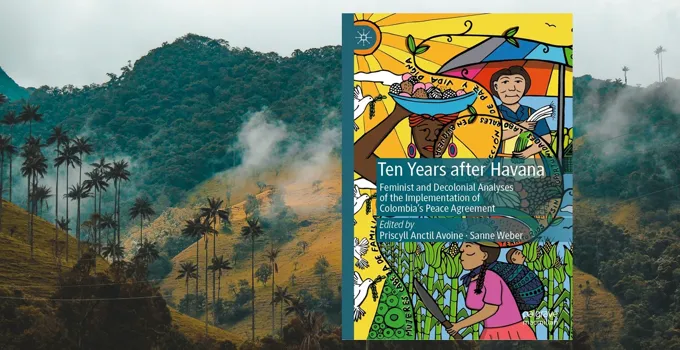
New book examines the challenges of building peace in Colombia
Ten years after Colombia's historic peace agreement, a new book explores the gap between ambitious peace policies and the realities faced by communities affected by the armed conflict. The book highlights the role of women, Afro-Colombian and Indigenous peoples as well as LGBTQI+ communities in building peace despite ongoing violence.
In 2016, the Colombian government and the FARC-EP guerrilla group signed a peace agreement that gained international recognition for its ambitious approach to gender equality, transitional justice and the reintegration of former combatants.
A decade later, the edited volume Ten Years After Havana: Feminist and Decolonial Analyses of the Implementation of Colombia’s Peace Agreement examines what has happened since the agreement was signed.
The book is edited by Priscyll Anctil Avoine, researcher at the Swedish Defence University, and Sanne Weber from Radboud University in the Netherlands.
“Colombia's peace agreement was groundbreaking in many ways, particularly in its approach to gender equality. But ambitious policies do not automatically translate into meaningful change for people affected by the armed conflict. We wanted to understand what peacebuilding actually looks like on the ground”, says Priscyll Anctil Avoine.
The gap between peace policies and reality
Rather than measuring progress through statistics and policy indicators, the book focuses on the experiences of people living in regions affected by decades of armed conflict. Drawing on feminist and decolonial perspectives, the contributing researchers examine how communities work to build peace while facing continued violence, inequality and struggles over land and natural resources.
The findings reveal a persistent gap between the promises of the peace agreement and its implementation. At the same time, they show how local organisations and social movements continue to drive change.
“One of our key findings is that grassroots organisations are essential to making peace possible. Women, LGBTQI+ communities, Afro-Colombian and Indigenous groups continue to defend their rights and territories, often under extremely difficult and dangerous conditions”, says Priscyll Anctil Avoine.
Lessons for future peace processes
The book’s 18 chapters also challenge traditional approaches to peacebuilding by showing how gender equality, access to land, environmental exploitation and security are closely connected. Through examples from different regions of Colombia, the chapters explore issues such as the reintegration of former combatants, sexual violence and the impact of resource extraction on local communities.
The editors argue that understanding these connections is essential for creating sustainable peace.
“Peace is not simply about signing an agreement or ending armed confrontation. It is also about addressing the inequalities and forms of violence that continue to shape people’s everyday lives. This is an important lesson for other peace processes around the world”, says Priscyll Anctil Avoine.
Publication
Ten Years After Havana: Feminist and Decolonial Analyses of the Implementation of Colombia's Peace Agreement, Palgrave McMillan (2027)
Editors: Priscyll Anctil Avoine, Swedish Defence University, and Sanne Weber, Radboud University.
Book launch 25 November
Welcome to the launch of the book, where researchers and some of the book’s chapter authors will discuss what the peace agreement has meant in practice and what lessons can be learnt from the peace process.
Read more and register by 20 November:
Book launch: Feminist and decolonial perspectives on Colombia's peace agreement
Page information
- Published:
- 2026-10-16
- Last updated:
- 2026-10-16