
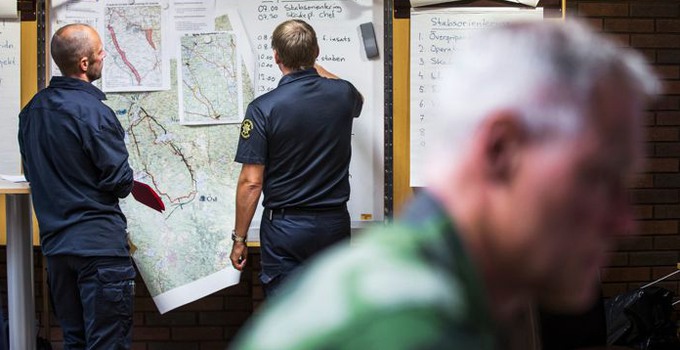
Photo: Johan Eklund, MSB (archive)
Structured exercises strengthen civil-military cooperation in total defence
Civil–military cooperation is a key aspect in building Sweden’s total defence. A new study from the Swedish Defence University now shows that exercises with a clear pedagogical structure and the right composition of participants can deliver results in efforts to strengthen the ability of civilian and military actors to work together.
The study was conducted as a qualitative case study during a civil–military total defence exercise in June 2024. The aim was to examine whether this type of exercise actually contributes to improved cooperation.
Analysing a total defence exercise
The researchers used participant observation and analysed the exercise with the help of an adapted version of the Constructive Alignment (CA) model. The model was used to link learning objectives, implementation, and evaluation of the exercise to the organisational support provided to participants.
Better results with fewer objectives
One clear conclusion is that the exercise benefited from having a limited number of clear objectives—in this case, evacuation and accommodation.
“This increased pedagogical precision and made it easier to follow up on the objectives. In previous exercises, complex and vague goals have led to fragmented cooperation and an inability to achieve the exercise’s aims,” says Erik Hedlund, Professor at the Department of Leadership and Command & Control.
“In addition, the exercise was divided into three clear organisational levels—strategic, regional, and local—reflecting the natural way of handling such events in real-life situations. This familiarity created a sense of realism among participants and thus contributed to increased understanding and learning,” he adds.
Cooperation built on relationships and support
Another success factor was that participants came from the same geographical and administrative context, with prior experience of working together.
“This improved the ability to quickly find common solutions and to understand each other’s resources and roles,” says Erik Hedlund.
The presence of legal expertise throughout the exercise also strengthened participants’ understanding of the relevant laws and regulations—an area that often causes uncertainty in similar exercises.
Two further improvements compared with previously studied exercises were the introduction of a joint decision-making method and a shared pedagogical model for group work. These elements streamlined the process and improved coordination.
Clear lessons for the future of total defence
In summary, the study shows that exercises are more effective when they have a few well-formulated learning objectives, build on existing relationships and contexts, include pedagogical and legal support, and are conducted with a unified structure and methodology.
The adapted CA model used as a tool proved effective for planning, conducting, and evaluating cooperation exercises in total defence.
“These results can help create more targeted and instructive exercises, thereby improving the ability to act in a coordinated manner in times of crisis and war,” says Erik Hedlund.
Publication:
Erik Hedlund and Aida Alvinius (2025): Building stronger ties: How constructive alignment boosts civil-military collaboration in crisis management exercises. International Journal of Emergency Services. (in press)
More research on civil-military cooperation
The study is part of the research project Civil–Military Cooperation, in which the researchers have published a further three studies on civil–military collaboration:
Leadership and trust crucial for successful crisis exercises
How civil-military cooperation affects Swedish total defence
More about
Page information
- Published:
- 2025-08-08
- Last updated:
- 2025-08-08