
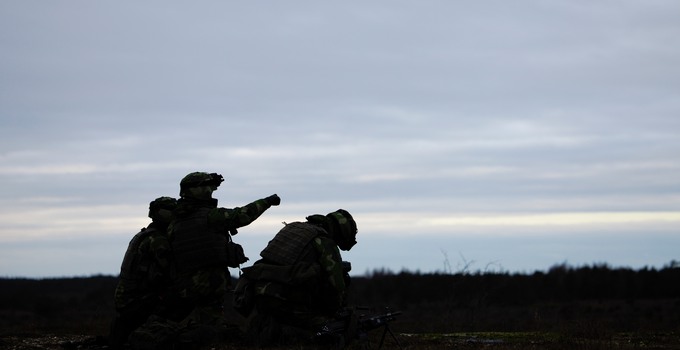
Photo: Emy Åklundh/The Swedish Armed Forces.
Systems science for defence and security
Systems science for defence and security is a field located at the intersection of the social sciences and engineering. The research addresses systems that contribute to or influence society’s defence, where both technological solutions and social factors play a central role.
The starting point of the field is that technical and social components must be understood together. The focus is therefore on how technologies and materiel for defence and security are developed, procured and used. Systems science for defence and security is a further development of the field of military technology.
Research that makes a difference
Central to the field is the study of systems in which technical and social components interact to create defence and security capabilities. In this context, capability refers to the potential of a society, organisation, group or individual to achieve a goal using the appropriate resources. One example of a research object is military units organised, equipped and trained for specific tasks in crises and war.
Developing such capabilities involves more than maintaining existing capacity. Organisations must be able to adapt and strengthen their systems over time, despite limited resources, so that the right capability is available at the right moment. This requires analysis of technological development, organisational structures and possible future needs.
Defence and security capabilities are influenced by many factors, both technical and social, and often change slowly. Consequently, there is a strong need for methods to analyse different development options and support decision-making on how both military and civilian systems should evolve.
The research contributes knowledge and methods for governing technological and capability development, in close collaboration with authorities, industry and academic partners. It spans several areas and is often conducted in cooperation with other universities, government agencies and organisations. Some central research areas are presented below.
Capability development and defence innovation
The development of defence and security capabilities is a central research area. The research is based on a sociotechnical systems perspective in which technological development is studied together with organisational and institutional factors.
The research addresses, among other things, how different actors, for example defence authorities and industry, organise and collaborate to develop new capabilities. Current topics include innovation management, the organisation of defence innovation, international cooperation, defence logistics and strategic materiel supply.
The research is conducted in collaboration with, among others, Linköping University, Stockholm University, Lund University and the University of Gothenburg.
Read more about the department’s research in capability development and defence innovation.
SEDU Centre for Capability Development and Innovation
Infrastructure resilience
This research area examines the ability of critical infrastructure to withstand, adapt to and recover from different types of threats and disruptions. This includes the protection of physical infrastructure on land, at sea and in the air, such as transport networks, ports, energy systems and communication systems. The area also covers cybersecurity aimed at protecting critical information systems from cyberattacks, espionage and data breaches.
The research adopts a holistic sociotechnical perspective and addresses issues such as availability and societal acceptance. It complements and connects technical research with policy issues in defence and societal security.
Partners include the Swedish Energy Agency, NATO’s Science for Peace and Security (SPS) programme, Blekinge Institute of Technology, Uppsala University and the Swedish Armed Forces.
Cybersecurity
Research on cybersecurity and cyber operations is mainly conducted through doctoral projects. The research focuses on how digital technology affects society and security beyond the purely technical domain.
Examples of research questions include the economic consequences of cyber incidents, psychological aspects of cybersecurity, incentives for strengthening security, and the development of situational awareness in the cyber domain.
The research is conducted in collaboration with Uppsala University, Lund University, Karlstad University, the Royal Institute of Technology (KTH), the University of Skövde, Cybercampus, the Centre for Cyber Defence, the Swedish Civil Defence Agency, the Knowledge Foundation (KK-stiftelsen) and the Swedish Armed Forces.
Space capability
The area of space capability addresses issues related to Sweden’s national space strategy. The focus includes space situational awareness and the robustness of space-based services.
The area is developing rapidly. The Swedish Defence University participates, together with KTH and several other universities, in a research school in space research funded by the Swedish National Space Agency.
Warfighting capability
Research in warfighting capability examines the interaction between technological development and modern warfare. The aim is to strengthen understanding of how new technologies affect military operations and how this knowledge can be used in the development of tactics, education and training.
The area overlaps with several other research fields, particularly cybersecurity, space capability, and intelligence and security studies, and the research is conducted in close collaboration with the other subjects at the Swedish Defence University.
Psychological defence
Research on psychological defence and cognitive warfare analyses how information influence operations and other hybrid threats can be identified, analysed and managed.
The studies examine the interaction between social and technical systems within society and the total defence system. The research includes international case studies—particularly within the EU and NATO—as well as analyses of Swedish resilience and cooperation between actors.
The work is carried out in collaboration with the Swedish Psychological Defence Agency and KTH.
Intelligence and security studies
Research in intelligence and security studies focuses on methods for intelligence analysis, hybrid threats and total defence. Particular attention is given to how digitalisation and AI influence intelligence organisations and analysts.
The research is carried out in close collaboration with other disciplines at the Swedish Defence University and is used in education as well as in collaboration with government agencies.
Since 2025, the Swedish Defence University’s Intelligence and security service platform has been located at the Department of Systems Science for Defence and Security. The platform functions as a virtual centre for research in the field.
Read more about the Intelligence and security services platform
Publications
Staff
Here you can search for employees at the Department of Systems Science for Defence and Security: